Showing posts with label Literacy. Show all posts

Friday, January 15, 2016

Making Plans: Going a Step Beyond

We ask the children to draw a plan before they begin their day because it reduces impulsive thinking, helps children focus, and supports them in centering themselves. An added bonus is that drawing their plans hones their fine motor skills, while telling a teacher the plan and watching her write it down strengthens communication and literacy skills.
A child talking with a teacher about her plan 

This January, after winter break, we decided to expand on our idea of having each child make a plan. On our work day before the children returned from their two week holiday, my co-teacher Sarah Anne and I sat down together and talked about each child. We have observed the children, listened to them and worked with them for several months now. How well do we know them? What are each child's strengths, her passions, her enthusiasms? And once we discussed those things about each child, we talked about what our hopes are for that child: such things as connecting further with others, engaging more deeply in activities, strengthening certain skills, or feeling more secure in the classroom.

Our aim was to see what would happen if we teachers suggested a possible path for each child. So instead of asking children to draw a plan of where they would like to begin their day, we guided their thinking with suggestions based on what we saw as their deepest passions. After we had our suggestions ready for the children, we could hardly wait until they came back to school the next day.

We were not disappointed by the children's reactions to our preparations. We saw an explosion of activity, many eager faces, and a lot of dedicated work. It seems we were correct in our identification of the children's interests. These positive teacher-child connections nourish both the children and us. It is gratifying when we find a way to offer meaningful work for the children. We get excited too!
This child created his deeply cherished  lovey, "Tag," out of paper

One child has shown us repeatedly that he is quite adept at creating paper hearts, so we asked him if he would like to make a plan to teach others how to do this. He agreed with a smile, and a small group spent a long time creating and decorating hearts. What a sweet way for this child to take on a leadership role, share a skill, and connect with peers.
Demonstrating how to make a paper heart


The final heart, decorated


Another child planned to make a tea cup so she could have tea with her daddy, affirming Sabot's belief that children will engage deeply when the subject is meaningful to them.
Writing a note to our studio teacher to help the child complete her plan


The tea cup, finally finished


This child's face lit up when she drew her beloved gymnastics class; another way to connect life at home and life at school. Actually, we noticed that several children wanted to draw family members, those most important people in the lives of young children.
"I'm going to draw the roads. Gymnastics: it's really hard to get there."
Completing her plan: roads and three people. Is she thinking about how she and her friend ride to class with  a parent?


We are in the beginning stages of this expanded way of thinking about having children make plans. So far we have noticed deeper engagement from everyone as they follow through with their intentions, and this deep engagement spills over to the rest of the day. There is more buzz of conversation in the classroom, more interest in other children's work, and more sustained collaborative play. These relationships--among the children themselves, and between children and teachers-- are a foundation for social and democratic learning.


Another child begins to draw her family

Her family on the road, going to Little Einstein's

At the end of every day now, we think about the children again. What did they do with our guided suggestions? Were our ideas appropriate and have we correctly understood at least one of their passions? Do we need to revisit and rethink our ideas for anyone? How can we expand on what they have done so far?


This child's plan was to make a cake for her mother.


We have just begun to share their work with the whole group at circle time. Will the children's ideas and creativity impact their peers? Will we discover other areas of interest? Is there a small group with similar interests who might work together on a project? We don't yet know where this way of thinking will take us. But we wait enthusiastically to find out.
A group making a plane, with grass underneath; then cutting the grass


Sunday, January 27, 2013

The Power of Books


For many, many weeks now the boys have been bringing books in to share with each other.  It has become a daily ritual for them, as you have probably noticed in the pictures from each week.  They go out into the hallway and pile on the pillows with one, or several books, usually about star wars, legos, and/or ninjago. These themes and characters have become a common culture for the group, a shared mythology.  

In previous years it has been Ninja Turtles, Pokemon, Transformers, and Star Wars, Greek myths and fairytales. There have been many incarnations of superheroes.  Who doesn't love stories of trials and triumph, power, magic, make-believe, fear, good and evil?  Every year we see it in one form or another because these myths explore the  big themes children wrestle with:  good and evil, power and vulnerability, danger and safety, heroes and villains, strength and weakness, challenge, growth, and transformation.  Maybe making sense of all these things, both symbolically in fiction, and in our real world, is the beginning of their own hero's journey.
 
Although we sometimes worry that the commercialization of these stories may lead to scripted play, we want to provide an environment where children can process their questions within the framework that captivates and makes sense to them.  Their careful study of these books, their loud and active role playing, and their studio work (representing what they know and theorize) are all methods to understand these big issues.  Having a shared mythology with other children, regardless of the origin, gives them a sense of belonging and community.  And having other children to process the story with, also helps them co-construct a shared understanding of the larger, real-life issues that these myths represent.

Just as the characters in these stories each have their roles and their trials and traits, the children in the Meadow Room find their place within the group.  Micah has found his way to a central place using these books. Often pre-readers will memorize the words of a story and then, using the pictures as cues, will learn to recite the story from memory.  This is one of the early stages of learning to read.  The other children are very compelled by Micah "reading" the stories that they just can't get enough of.  His ability also adds to the group's independence.  Children at this age usually enjoy a little more separation from the teachers, which is why the physical layout of our room works so well for this age children.  Micah's ability to read to the group takes this independence one step farther.  The other day as I was listening to them when they were all crowded together, Micah had a book that he said he couldn't read yet and so I offered to read it for them, but they said no.  This was so interesting since in most circumstances they love to be read to.  I took that to mean that this was their space, like a fort where grown-ups don't intrude, or maybe it is their story and I am outside of the culture.  Maybe they are feeling strong and confident; becoming the heroes of their own story.  The books bring power to real life in many ways it seems.


Sunday, November 11, 2012

EATING THE ALPHABET: Emergent Literacy in the Garden Room

EATING THE ALPHABET:

Emergent Literacy in the Garden Room

-->
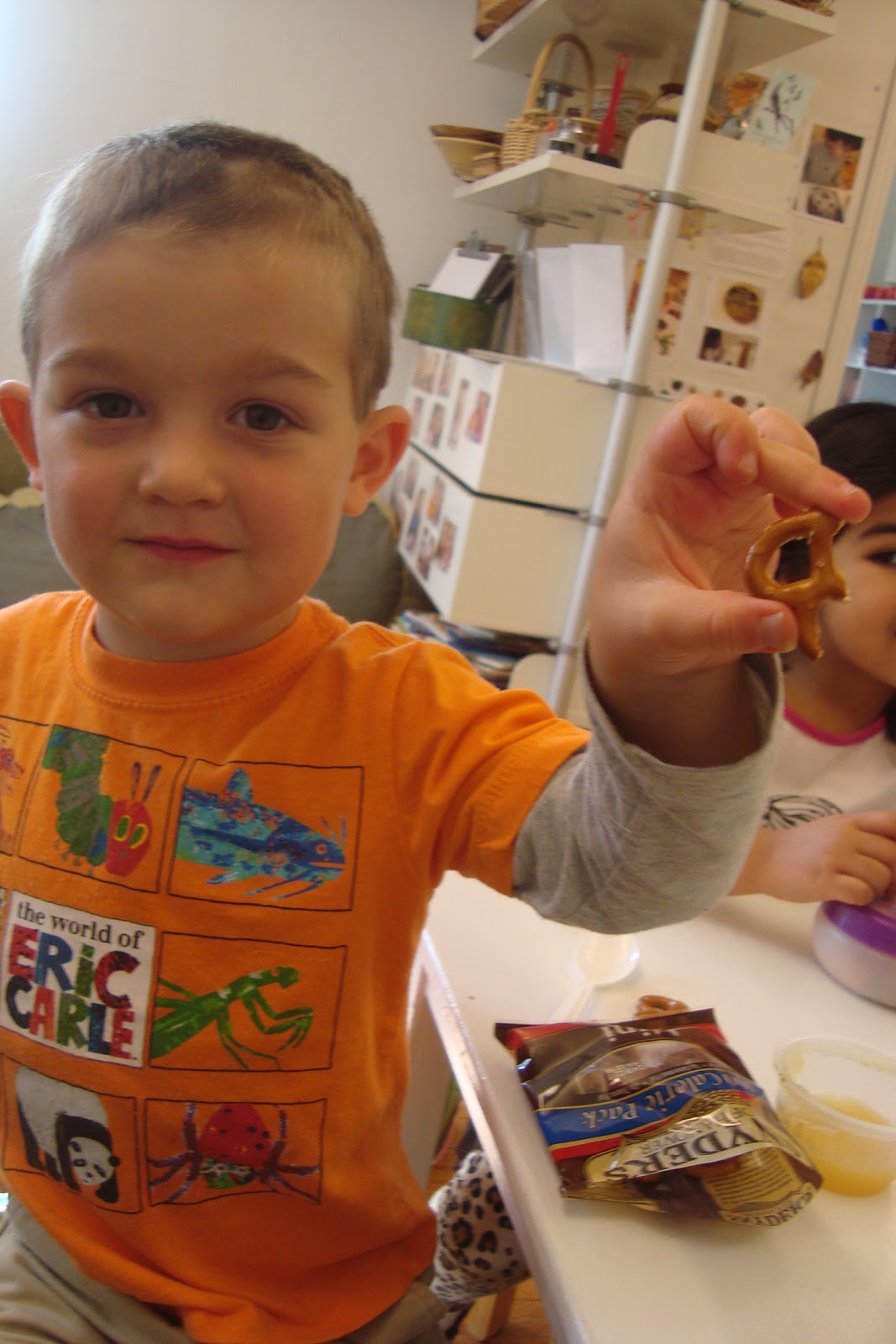
One day during snack a child held up a pretzel: 
“It’s a P.  I took a bite and it’s a P."


I handed him the camera so he could take a photo of his pretzel P.
Then he stated:
“If I bite that bit, it will make a D!”
So he did, and then announced: 
 "Now it's a D."


Next he took a photo of this new letter.


The children at the snack table were clearly delighted with the transformation of the pretzel.

-->
That same day, out on the playground children were busy hunting for sticks, pebbles and leaves.  The bright autumnal weather had made the soil very dry and dusty and it wasn’t long before the children noticed that they could make marks in the dirt with their sticks.


 A block of wood became a “smoother” that could erase letters, wiping the dust flat to create even more letters.


-->

-->

What we see in these little moments are examples of the power of emergent literacy – children are transforming objects into letters through a process of deconstructing an object (biting a pretzel), which is then constructed into something new (an alphabet letter), only to be re-constructed (a different alphabet letter). 

The dusty playground dirt is also a place of transformation as children create letters, erase them and create more letters. 
Children are masters of finding the potential in the mundane, whether it’s a pretzel or a small area of dirt.  These small creative acts are evidence of very powerful thinking.